Your website content plays an important role in how potential customers discover, understand, and interact with your business. From blog articles and service pages to FAQs, case studies, and downloadable resources, every piece of content contributes to the overall experience visitors have on your website.
However, publishing content without a clear purpose can make it difficult to achieve consistent results. A strong Marketing Strategy gives your business a structured approach to deciding what content to create, who it is for, what purpose it serves, and how it can support your wider marketing goals.
Instead of creating articles simply because they are related to your industry, a strategic approach focuses on the questions customers are asking, the problems they are trying to solve, and the information they need before making a decision. This can help your website attract more relevant visitors while giving those visitors clearer opportunities to engage with your business.
In this guide, we’ll look at how to build a practical website content strategy, how to plan content around the customer journey, and how to turn your website content into a long-term source of qualified leads.
What Is a Website Content Strategy?
A website content strategy is a structured plan for deciding what content your business should create, who that content is intended for, and how it should support your business objectives.
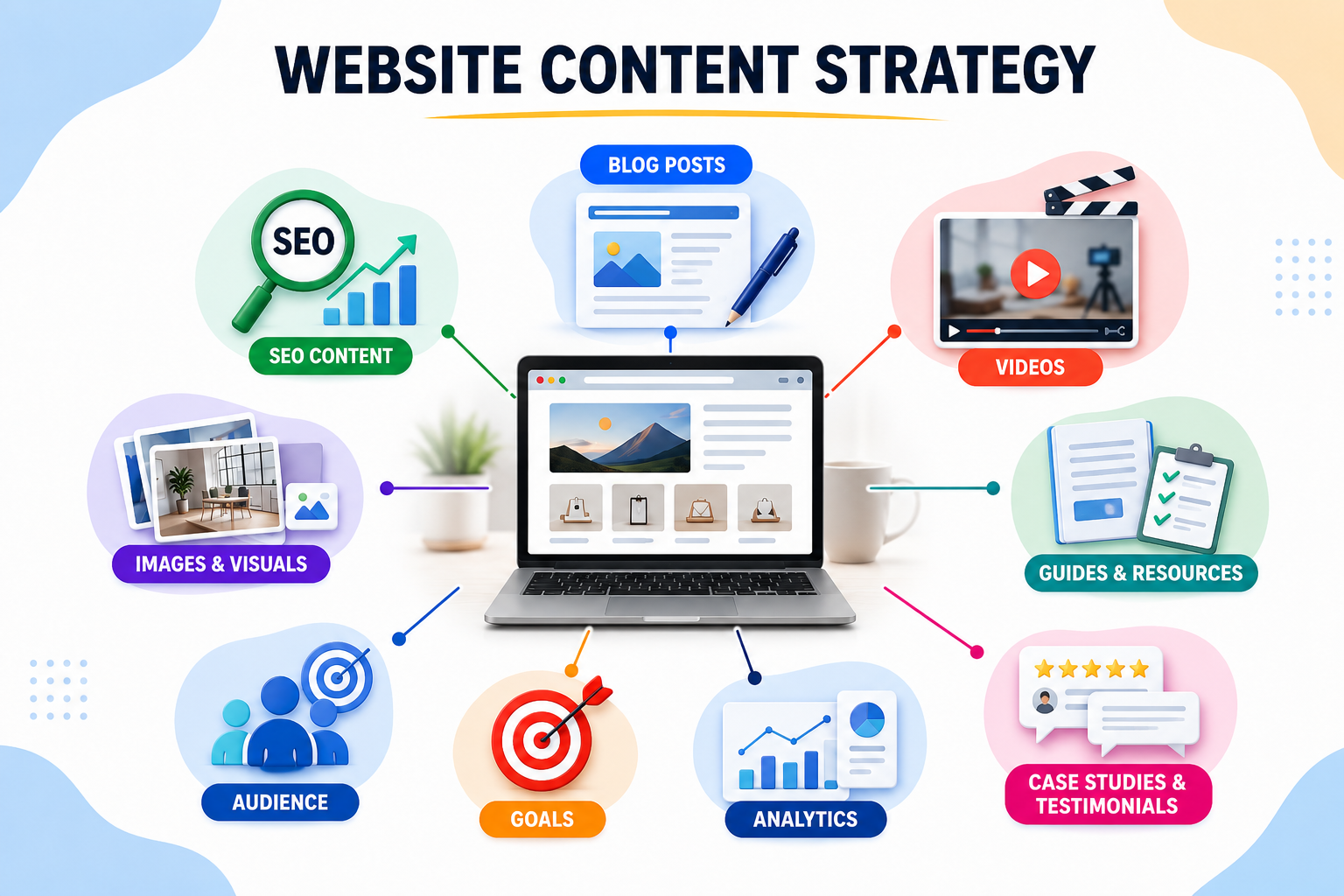
This includes more than blog posts. Your website content can include service pages, landing pages, FAQs, case studies, guides, videos, lead magnets, and other resources that help visitors understand your business and make informed decisions.
A good content strategy should connect your audience’s needs with your business goals. HubSpot’s approach to content marketing strategy highlights the importance of planning content around your audience, goals, distribution, and the outcomes you want to achieve.
The goal isn’t to create as much content as possible. It is to create useful content with a clear purpose.
For example, one article might be designed to answer an early-stage question, while another page may explain a specific service. A case study can demonstrate results, while a downloadable guide can encourage a visitor to provide their contact details.
When each piece has a defined role, your website becomes easier to manage and more useful to potential customers.
Why Your Website Needs a Clear Content Direction
Without a clear content direction, businesses can end up publishing topics that are disconnected from their audience or wider marketing goals.
You may have several blog posts that receive traffic but do little to generate enquiries. You may also have service pages that explain what you offer but fail to answer the questions customers have before they are ready to contact you.
A clear strategy helps connect these different pieces.
Before creating new content, consider:
- Who is this content for?
- What problem does it address?
- What question does it answer?
- What stage of the buying process is the reader in?
- What should the reader do next?
- How does this content support a wider business goal?
This approach can also prevent businesses from creating content simply for the sake of publishing something new.
Every page should have a reason for existing. Some content should attract visitors, some should educate them, some should build trust, and some should help them take action.
When these purposes work together, your website can guide visitors through a more logical path from their first interaction to an enquiry.
Start With the People You Want to Reach
Before deciding what content to publish, you need to understand who you are trying to reach.
Your audience’s needs should influence the topics you cover, the language you use, and the type of information you provide.
Start by considering the problems your potential customers experience. What questions do they ask before contacting a business like yours? What concerns might stop them from making a decision? What information would help them compare their options?
Customer enquiries, sales conversations, support questions, reviews, and website analytics can all provide useful insights.
You can also look at the terms people use when searching for solutions online. This can help identify content opportunities that are directly connected to real customer needs.
The more clearly you understand your audience, the easier it becomes to create content that feels useful rather than generic.
Map Content to the Customer Journey
Not every visitor arrives at your website ready to make an enquiry. Some are discovering a problem, while others are already researching solutions or comparing providers.
Your content should reflect these different stages.
Salesforce explains how the customer journey involves different stages and interactions between customers and a business. Understanding these stages can help businesses determine what information customers need at different points in their decision-making process.
Content for People Discovering a Problem
At the beginning of the journey, potential customers may not fully understand the solution they need.
Educational blog posts, guides, FAQs, and explanatory articles can help them understand their problem and explore possible solutions.
For example, someone experiencing a slow website may initially search for information about why websites become slow rather than immediately looking for a web development company.
Content at this stage should focus on answering questions and providing useful information rather than pushing for an immediate sale.
Content for People Comparing Solutions
Once someone understands their problem, they may begin researching different ways to solve it.
This is where comparison articles, service explanations, case studies, reviews, and detailed guides can become valuable.
At this stage, visitors often want to understand their options, assess potential providers, and determine which solution is most appropriate for their needs.
Your content should therefore provide enough detail to help them make an informed decision while demonstrating your experience and expertise.
Content for People Ready to Take Action
Visitors further along the customer journey may already know what they need.
They may be looking for a specific service, pricing information, a quote, or a way to contact a provider.
Service pages and landing pages should make this process straightforward. Clear explanations, trust signals, relevant information, and strong calls-to-action can help reduce friction and make it easier for visitors to take the next step.
Choose the Right Content for Each Stage
Different types of content serve different purposes. A successful strategy doesn’t rely on one format but uses a combination of content to support visitors throughout their journey.
Educational Blog Content
Blog articles can answer common questions, explain complex topics, and introduce potential customers to problems they may not yet know how to solve.
They can also create opportunities to target relevant search queries and bring new visitors to your website.
However, the purpose of a blog shouldn’t be limited to attracting traffic. The article should provide genuine value and connect naturally to other relevant pages on your website.
Service and Solution Pages
Service pages are designed for visitors who want more specific information about what your business provides.
These pages should clearly explain the problem your service solves, what is included, who it is suitable for, and what visitors can do next.
Your homepage also plays an important role in communicating your offer. A well-structured homepage that converts can help visitors quickly understand what your business does and where they should go next.
Case Studies and Trust-Building Content
Potential customers often want evidence before choosing a provider.
Case studies, testimonials, reviews, examples of previous work, and detailed project information can help demonstrate experience and reduce uncertainty. You can also explore relevant case studies to see examples of how businesses have approached different digital marketing challenges.
Trust-building content is especially useful for visitors who are comparing providers and want reassurance that they are making the right choice.
Lead Magnets and Downloadable Resources
Some visitors may not be ready to contact your business immediately.
A useful guide, checklist, template, report, or other resource can provide additional value while creating an opportunity to capture a lead.
For example, a relevant lead magnet for your website can encourage visitors to exchange their contact details for useful information related to a problem they are trying to solve.
The key is making sure the resource is genuinely relevant to the audience and connected to your services.
Build Topics Around Real Customer Questions
One of the most effective ways to develop content ideas is to start with the questions your customers are already asking.
Think about the questions people ask before they contact you, during conversations with your team, and when they are deciding whether to purchase.
These questions can become:
- Blog topics
- FAQs
- Service page sections
- Comparison guides
- How-to articles
- Case studies
- Downloadable resources
This approach helps prevent content from becoming disconnected from the actual customer experience.
It also allows businesses to build a collection of useful resources that answer questions at different stages of the decision-making process.
Rather than asking, “What should we write about this month?”, you can ask, “What does our audience need help understanding?”
That shift can make your content planning much more focused.
Make Every Piece of Content Work Toward a Goal
Every piece of content should have a clear purpose. Not every page needs to generate an immediate enquiry, but every page should contribute to the overall customer journey.
Attract the Right Visitors
Content can help bring potential customers to your website through search engines, referrals, social media, and other channels.
The focus should be on attracting people who are relevant to your business rather than simply increasing visitor numbers.
If your website attracts plenty of visitors but very few enquiries, it may be worth examining why your website gets traffic but no enquiries.
Build Trust and Credibility
Useful, accurate, and well-structured content can demonstrate your knowledge and help potential customers feel more confident about your business.
This can be particularly valuable when customers are comparing providers or considering a service that requires a significant investment.
Encourage the Next Step
Content should give visitors a logical next step.
Depending on the page, this could mean reading another article, viewing a service page, downloading a resource, completing a contact form, or requesting a consultation.
For visitors who are ready to enquire, a well-designed contact process can make a significant difference. Optimising contact forms can help reduce unnecessary friction and make it easier for potential customers to get in touch.
Connect Your Content Across Your Website
A content strategy becomes more effective when individual pages work together rather than existing in isolation.
For example, a blog post can link to a related service page. A service page can direct visitors to a relevant case study. A guide can link to supporting articles and eventually lead visitors towards a contact page.
This creates a connected website structure that helps visitors discover more relevant information.
Internal linking can also help search engines understand the relationship between different pages on your website.
When creating new content, look at your existing articles and pages to identify opportunities to connect related topics.
This can also help older content continue to provide value instead of becoming isolated as your website grows.
Measure Whether Your Content Is Generating Results
Creating content is only one part of the process. You also need to understand whether that content is contributing to your business goals.
Organic Traffic
Monitor whether your content is attracting visitors through search engines and whether those visitors are relevant to your target audience. Tracking your visibility and working to improve your search engine ranking can help you understand whether your content is reaching the people you’re trying to attract.
High traffic numbers can be useful, but they shouldn’t be the only measure of success.
Engagement
Look at how visitors interact with your content. Metrics such as time spent on pages, engagement, and navigation to other pages can provide clues about whether visitors find the content useful.
Enquiries and Conversions
Ultimately, businesses need to understand whether content contributes to meaningful business outcomes.
Track enquiries, contact form submissions, phone calls, downloads, bookings, and other relevant conversions.
A page that receives modest traffic but consistently contributes to qualified enquiries may be more valuable than an article that receives thousands of visitors without generating meaningful actions.
Regularly reviewing these results allows you to identify which topics perform well and where your strategy needs improvement.
Common Questions About Website Content Strategy
How often should a business publish new website content?
There is no universal publishing schedule that works for every business. The priority should be creating useful, relevant content consistently rather than publishing frequently just to meet a target. A realistic schedule that your business can maintain is generally more valuable than producing large amounts of low-quality content.
What type of content generates the most leads?
The most effective content depends on your audience, industry, and stage of the customer journey. Service pages, case studies, comparison content, lead magnets, and educational articles can all contribute to lead generation when they address genuine customer needs. The strongest approach is usually a combination of content types rather than relying on a single format.
Does website content help with SEO?
Yes. High-quality content can help businesses target relevant search queries, answer customer questions, and provide useful information to searchers. However, content should be created primarily for the audience rather than written solely to include keywords. Strong content works best when it combines relevance, usefulness, clear structure, and a good overall website experience.
How do I know if my content strategy is working?
Look beyond traffic alone. Review organic visibility, engagement, enquiries, conversions, and the quality of leads generated through your content. Comparing these results over time can help you identify which topics and pages are contributing to business growth and where adjustments may be needed.
Create a Website Content Strategy That Supports Business Growth
A strong website content strategy gives your business a clearer way to plan, create, organise, and measure content.
Instead of publishing articles without a defined purpose, you can build content around real customer questions and create different resources for different stages of the customer journey.
This helps your website become more than an information source. It can become a structured pathway that attracts relevant visitors, builds trust, answers important questions, and encourages potential customers to take the next step.
The most effective strategies are not necessarily the ones that publish the most content. They are the ones that consistently create useful information for the right audience and connect that content to clear business objectives.
Turn Your Website Content Into a Long-Term Lead Generation Asset
Your website content should continue working for your business long after a page is published. With the right planning, individual articles, service pages, resources, and conversion points can work together to attract visitors and support them throughout their decision-making process.
By understanding your audience, creating content around genuine questions, connecting pages across your website, and measuring meaningful results, you can build a content strategy that supports both visibility and lead generation.
If you’re ready to create a more structured approach to your website content and turn your online presence into a stronger source of potential customers, talk to us today to discuss how we can help.